
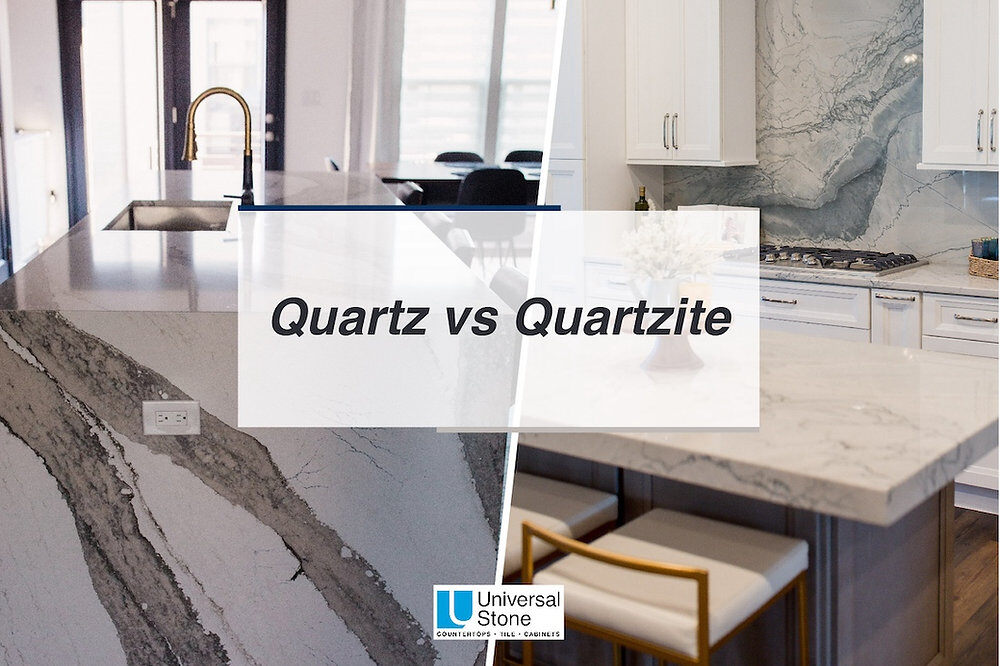
Quartz and quartzite are two of the most requested countertop materials at Universal Stone, and two of the most confused. The names are almost identical, both come in bright whites with soft veining, and both are durable. But they are made very differently, and that changes how they look, how you care for them, and what they cost.
The short answer: quartzite is a natural stone cut from a quarry; quartz is an engineered surface made from crushed quartz and resin. Pick quartz if you want consistent color and no maintenance. Pick quartzite if you want one-of-a-kind natural stone that stands up to heat and sun, and you don't mind sealing it.
Quartz vs Quartzite at a Glance
| Quartz (engineered) | Quartzite (natural stone) | |
|---|---|---|
| What it is | About 90–93% ground natural quartz bound with resin and pigment | Sandstone transformed by heat and pressure into solid stone |
| Look | Consistent color and pattern from slab to slab; can mimic marble | Every slab is unique, with natural veining, depth and movement |
| Sealing | Never | At install, then periodically |
| Stains | Non-porous, highly stain resistant | Resists stains well when sealed |
| Heat | Resin can scorch; use trivets | Very heat resistant |
| Scratches & chips | Very scratch resistant | Harder than glass; edges can chip if hit hard |
| Outdoors / sun | Not recommended; UV can yellow resin | Yes |
| Typical installed cost* | About $65–$150 / sq ft | About $95–$200 / sq ft |
*Typical ranges; your price depends on the slab, thickness, edge profile and layout. In-stock slabs are often the best value.
What Is Quartz?
Quartz countertops are engineered. Manufacturers crush natural quartz, mix it with a small amount of resin and pigment, and press it into slabs. The result is a dense, non-porous surface with very consistent color, which is why quartz is so popular for clean white kitchens, large islands where seams need to match, and marble looks without marble's upkeep.
Browse popular options like Calacatta Venatino, Mykonos and Calacatta Amalfi, or see our full quartz countertop selection.
What Is Quartzite?
Quartzite is a natural metamorphic stone. It starts as sandstone and, over millions of years of heat and pressure, the quartz grains fuse into one of the hardest countertop stones available. Each slab is cut straight from the quarry, so the veining, color and movement are one of a kind. Even two slabs from the same block can look noticeably different, which is why we recommend choosing your actual slabs in person.
Customer favorites include Taj Mahal, Belvedere, Mercury Grey and Sea Pearl. See the full marble & quartzite collection.
Durability: Which Is Stronger?
Both are among the most durable countertops you can buy, but they are tough in different ways.
- Scratches: both resist everyday knife and pot scratches. Genuine quartzite is harder than glass.
- Heat: quartzite wins. It handles a warm pan without damage, while the resin in quartz can scorch or discolor. Use trivets on quartz.
- Stains: quartz wins. It is non-porous, so wine, coffee and oil wipe right off. Quartzite resists staining well once it's sealed.
- Chips: natural stone edges can chip from a hard hit. An eased or rounded edge profile helps on busy islands.
- Sunlight: quartzite won't fade, so it's the better choice for outdoor kitchens and sunny rooms. Quartz is best kept indoors.
Care and Maintenance
Quartz is about as easy as it gets: warm water and mild dish soap, no sealing, ever. Avoid harsh chemicals like oven cleaner or bleach, and don't set hot pans directly on it.
Quartzite needs a little more attention. It should be sealed when it's installed and resealed periodically. To check, put a few drops of water on the surface; if the stone darkens within a few minutes, it's time to reseal. Clean daily with a pH-neutral stone cleaner and wipe up spills promptly. Our care and maintenance guide covers both materials.
Cost: Is Quartzite More Expensive Than Quartz?
In most cases, yes. Installed, quartz typically runs about $65–$150 per square foot, while quartzite runs about $95–$200 per square foot. A few things drive the final price:
- The specific slab. Quartz price depends on how complex the pattern is to manufacture. Quartzite price depends on how rare the stone is and where it's quarried.
- Thickness and edge profile. Thicker slabs and mitered or decorative edges add fabrication time.
- Layout. Large islands, waterfall ends and many cutouts increase cost.
- In-stock vs special order. Choosing an in-stock slab is one of the easiest ways to save.
Quartz is usually the more budget-friendly option, but premium quartz designs can overlap with entry-level quartzite, so it's worth pricing both.
Appearance: Consistent vs One-of-a-Kind
Quartz gives you control. The color you see on the sample is very close to what goes on your counters, and seams are easier to match. It's available in solid whites, concretes, and marble-look veining.
Quartzite gives you character. The depth, crystal sparkle and natural movement can't be reproduced in a factory. Color ranges are more limited (mostly whites, greys, taupes and some bold blues and greens), but no one else will have the same kitchen.
Which Should You Choose?
Choose quartz if you want a consistent look, the lowest maintenance, a busy family kitchen with lots of spills, or a marble look on a tighter budget.
Choose quartzite if you want natural stone with unique veining, you cook with a lot of heat, the countertops get direct sun or go outdoors, or you're investing in a statement island.
Still undecided? Try both in our free kitchen visualizer, then see the real slabs side by side.
Quartz vs Quartzite FAQ
Is quartzite more expensive than quartz?
Usually, yes. Installed, quartz typically runs about $65–$150 per square foot and quartzite about $95–$200. Pattern, thickness, edge profile and slab availability move the price, and in-stock slabs are often the best value. Some premium quartz designs cost as much as an entry-level quartzite.
Are quartz and quartzite the same thing?
No. Quartzite is a natural stone quarried in solid slabs. Quartz countertops are engineered: crushed natural quartz (about 90–93%) bound with resin and pigment. The names are similar because both are made mostly of the mineral quartz.
Which is better for a kitchen, quartz or quartzite?
Both are excellent kitchen countertops. Choose quartz for consistent color, zero sealing and the lowest upkeep. Choose quartzite for one-of-a-kind natural veining and better heat and UV resistance, and plan on sealing it.
Does quartzite need to be sealed?
Yes. Quartzite is less porous than granite or marble, but it should be sealed at installation and resealed periodically. A quick test: if water drops darken the stone within a few minutes, it's time to reseal. Quartz never needs sealing.
Which handles heat better?
Quartzite. It is formed by heat and pressure, so a warm pan won't hurt it. The resin in quartz can scorch or discolor from a hot pot, so always use trivets on quartz.
Can quartz or quartzite be used outdoors?
Quartzite can. Most quartz is not recommended for outdoor kitchens because direct sunlight can fade or yellow the resin over time.
How can I tell real quartzite from marble or dolomite sold as quartzite?
True quartzite is harder than glass, so it will scratch a glass tile, and it won't etch when a drop of lemon juice or vinegar sits on it. Some stones sold as "soft quartzite" are actually dolomite or marble and will etch. Ask to test a sample in our showroom before you choose.
See Quartz and Quartzite Slabs in Charlotte
Universal Stone fabricates and installs quartz, quartzite, granite, marble and porcelain countertops for homes and businesses across Charlotte, Huntersville, Lake Norman, Mooresville, Concord, Matthews and Rock Hill. Visit our slab warehouse at 4806 Rozzelles Ferry Rd or our Ballantyne Design Center to compare materials in person, or request a free estimate. You can also call us at (704) 394-1221.