
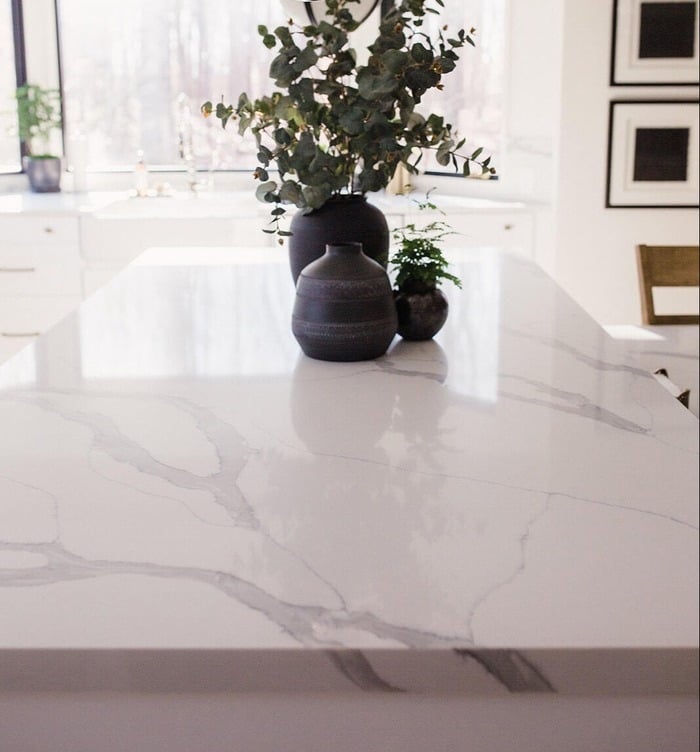
Quartz is the most requested countertop material in Charlotte kitchens right now, and for good reason. It looks like natural stone, never needs sealing and stands up to busy family life. But once you start shopping, the choices pile up fast: hundreds of colors, two thicknesses, polished or suede, in-stock or special order, slab or remnant.
This guide walks you through how to choose the right quartz for your home, based on more than 20 years of helping Charlotte homeowners, builders and designers pick their countertops.
Why Charlotte Homeowners Choose Quartz
Quartz countertops are engineered from roughly 93% natural ground quartz and 7% resins and pigments. That gives you a surface that is:
- Non-porous: resists stains, bacteria and moisture, with no sealing ever.
- Consistent: the slab you pick looks like the sample, and seams are easier to match on long runs and big islands.
- Low maintenance: warm water and mild soap are all it needs.
- Versatile: from bright whites and marble looks to concrete greys and deep blacks.
Quartz does have two limits worth knowing up front. It isn't heat-proof, so use trivets for hot pans. And it isn't recommended outdoors, because sunlight can fade it. If either is a dealbreaker, read our porcelain vs quartz comparison.
Step 1: Pick a Look (Color and Pattern)
Start with the overall feel you want, then narrow down.
- Marble-look whites: the most popular category by far. Calacatta-style slabs have bold veining, like Calacatta Venatino, Calacatta Amalfi and Calacatta Iris. For softer, quieter veining, look at White Lace.
- Warm whites with gold veining: pair beautifully with brass hardware and wood tones. See Mykonos Gold and Calacatta Gold.
- Clean solids and near-solids: for modern or minimal kitchens. Try Pure White or Crystal White.
- Concrete and greys: an industrial look without real concrete's upkeep, like Concrete.
- Darks: high contrast with white or light oak cabinets, like Alabaster Noir.
Tip: look at a full slab, not just a small sample. Veining on a marble-look quartz can look very different across a 10-foot island than on a 4-inch chip.
Step 2: Choose a Thickness
3cm (about 1 1/4") is the standard for kitchen counters. It's sturdy, doesn't need a built-up edge and works with most edge profiles.
2cm (about 3/4") is lighter and less expensive. It's common for bathroom vanities and can be laminated at the edge to look thicker on a kitchen counter.
Step 3: Polished, Suede or Matte?
Polished is the classic glossy finish. It's easy to wipe down and makes colors and veining look their richest.
Suede, honed and matte finishes have a soft, low-sheen feel that hides glare and reads more like natural stone. They can show fingerprints and oils a little more, so they need a quick wipe more often. Some slabs, like Aria, come in both. Our finish guide goes deeper.
Step 4: Pick an Edge Profile
The edge changes the look more than most people expect. An eased or slightly rounded edge is clean, modern and kind to busy families. Bevels, ogees and bullnoses feel more traditional. Mitered edges make a counter look extra thick, and they're especially striking on a waterfall island. See all the options on our edge profiles page.
Step 5: In-Stock, Special Order or Remnant?
- In-stock slabs are usually the best value and the fastest option. You can walk the actual slab before it's cut. Browse our in-stock selection on the quartz page.
- Special order: we partner with leading quartz brands, including Cambria, Caesarstone, Silestone, MSI and HanStone, so if you've seen a specific color elsewhere, we can usually get it.
- Remnants are leftover pieces from larger jobs. They're perfect for vanities, laundry rooms, bars and fireplace surrounds at a lower price. Check our remnants page.
Step 6: Plan Your Layout and Seams
Quartz slabs come in fixed sizes, so big islands and L-shaped runs may need a seam. A good fabricator plans seams where they're least visible and lines up the veining across them. This matters most on marble-look quartz with bold veins. We lay out your slabs with you before anything is cut.
What to Expect: From Showroom to Installation
- Visit and select: compare samples at our Ballantyne Design Center or walk full slabs at our 35,000-square-foot slab warehouse.
- Estimate: send us measurements or a sketch for a free quote.
- Template: once cabinets are installed, we measure your space precisely.
- Fabrication: your slabs are cut, edged and polished in our own Charlotte shop.
- Installation: our installers set, seam and finish your counters.
Caring for Quartz Countertops
Daily care is simple: warm water, a soft cloth and a little mild dish soap. Skip bleach, oven cleaner, abrasive powders and scouring pads, which can dull the surface over time. Always use trivets under hot pans and a cutting board for knives. More tips are in our care and maintenance guide.
Quartz Countertops FAQ
How much do quartz countertops cost in Charlotte?
It depends on the slab, the thickness, the edge profile and your layout. In-stock quartz and remnants are usually the best value, and premium marble-look designs cost more. Send us your measurements or a sketch and we'll give you a free estimate.
Should I choose 2cm or 3cm quartz?
3cm is the standard for kitchen counters and doesn't need a built-up edge. 2cm is lighter and common for bathroom vanities, or it can be laminated at the edge for a thicker look. We can show you both finished edges in the showroom.
Do quartz countertops need to be sealed?
No. Engineered quartz is non-porous, so there's nothing to seal. Clean it with warm water, a soft cloth and mild soap, and avoid bleach, abrasive pads and harsh chemicals.
Can I put hot pans on quartz?
No. The resin that binds quartz can scorch or discolor from a hot pot or pan, so always use a trivet. If hot pans regularly land on your counters, look at porcelain or granite.
Can quartz be used outdoors?
We don't recommend it. Direct sunlight can fade or yellow quartz over time. For outdoor kitchens we'd steer you to porcelain or granite.
Which quartz brands do you carry?
We stock our own selection of quartz slabs and also special order from partner brands including Cambria, Caesarstone, Silestone, MSI, HanStone and others. If you've seen a color you like elsewhere, bring the name and we'll check.
Can I use a quartz remnant to save money?
Often, yes. Remnants are leftover pieces from larger jobs and are a great value for vanities, laundry rooms, bar tops and fireplace surrounds. Availability changes daily, so call or check our remnants page.
Where can I see quartz slabs in Charlotte?
Visit our slab warehouse at 4806 Rozzelles Ferry Rd to walk full slabs, or our Design Center at 16615 Riverstone Way in Ballantyne. Call (704) 394-1221 and we'll pull slabs for you before you arrive.
Shop Quartz Countertops in Charlotte
Still deciding between quartz and natural stone? Our quartz vs quartzite guide breaks it down, and the free kitchen visualizer lets you try colors in a room before you visit.
Universal Stone has fabricated and installed countertops in the Charlotte area since 2003. Walk full slabs at our 35,000-square-foot slab warehouse at 4806 Rozzelles Ferry Rd, or compare samples at our Design Center at 16615 Riverstone Way in Ballantyne. Call (704) 394-1221 or request a free estimate.